This Clay + Tech feature is made possible with the support of L&L Kilns, a sponsor of MoCA/NY.

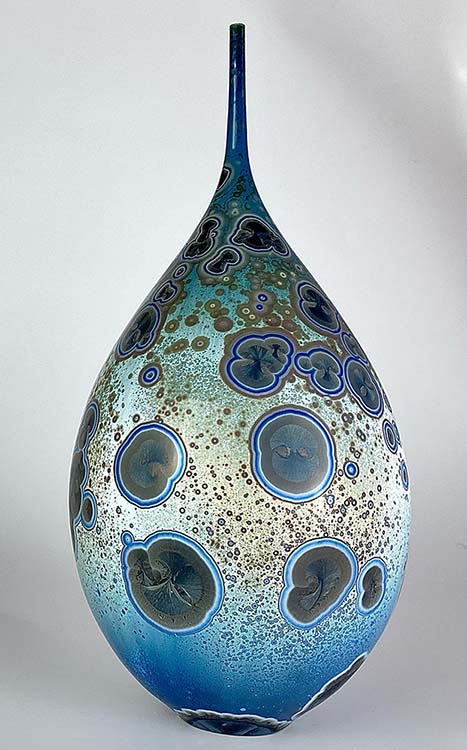
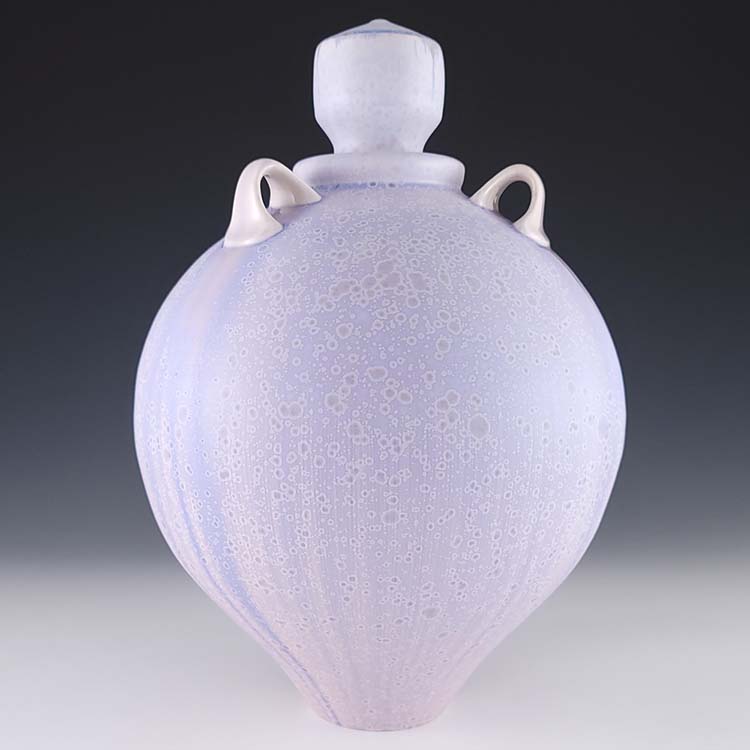
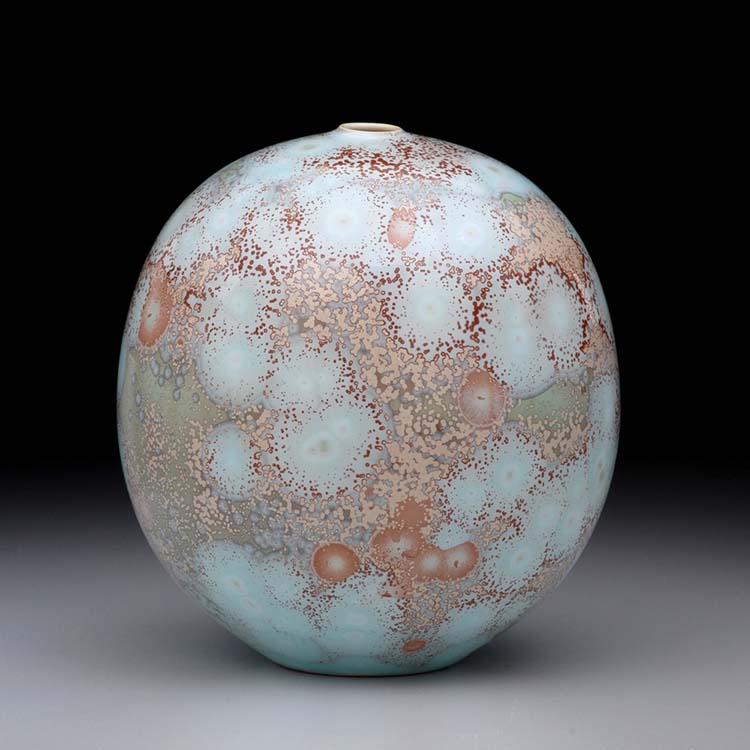
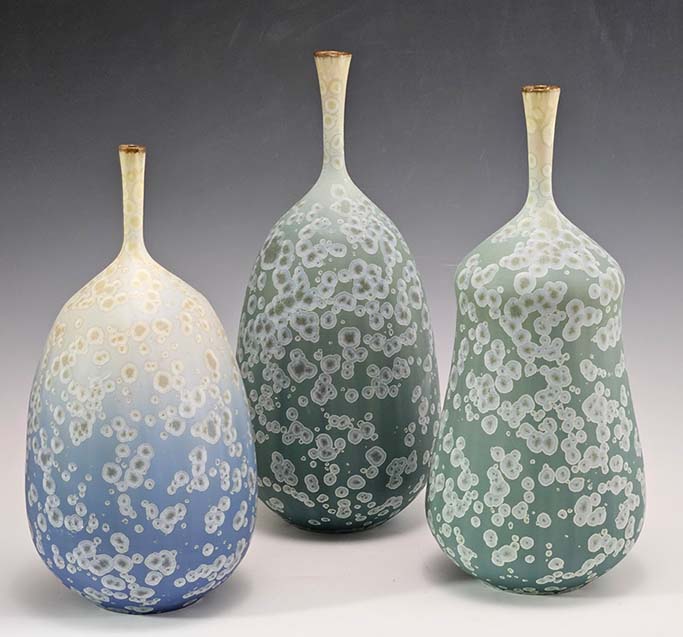
What are crystalline glazes? A very simple definition would suggest that any glaze that creates crystalline structures as a result of a slow cooling cycle can be classified as a crystalline glaze. The fuller truth, however, is that there are many categories of crystalline glazes: silky matte, microcrystalline, aventurine, oil spot, and the most commonly used, macrocrystalline (gloss and matte). One might wonder what is so special about these glazes. Personally, I am drawn to their unpredictable nature—the sparkles that emerge in aventurines, the silky smooth surfaces and intricate patterns achieved in matte glazes, and the highly reflective quality and depth revealed in gloss crystalline glazes. They are beautiful in so many ways. Introducing a reduction atmosphere, exposing the glaze to an acid bath, or simply reheating the piece to enhance color and contrast in a strike firing further expands the possibilities. My fascination grows deeper with each firing, each experiment, and every workshop.
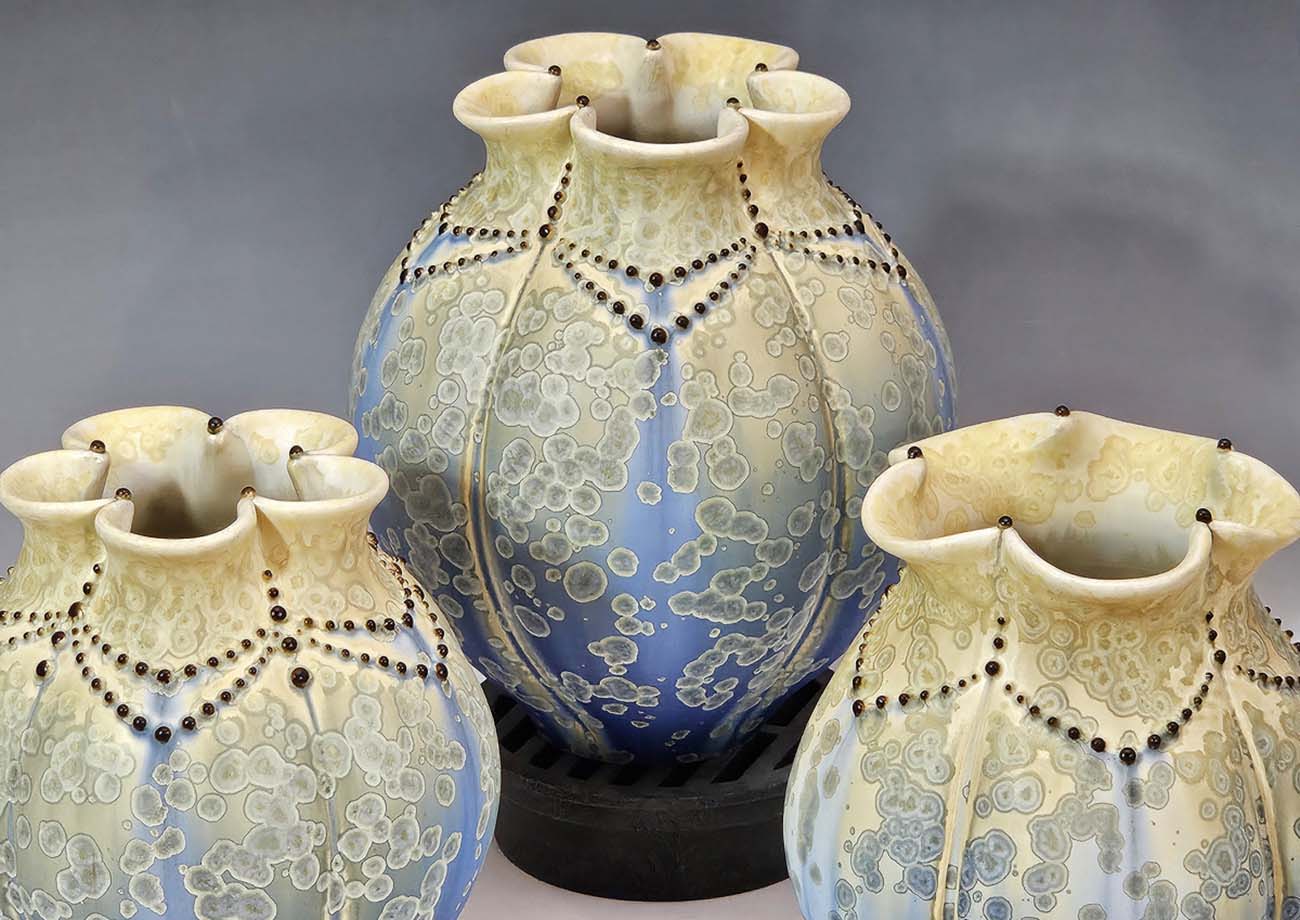
My focus has always been cone 10 gloss macrocrystalline glazes, but all crystalline variations rely on the same variables, which can make them somewhat fickle. These variables include raw glaze materials and commercial frits, application method, glaze thickness, firing temperatures, glaze flow, clay bodies used, and the forms created—vertical surfaces versus flat surfaces—and perhaps most importantly, a carefully designed cooling cycle that encourages the growth of the desired crystal size and style, as well as secondary crystals that may develop at much lower temperatures than the primary macrocrystalline structures. However, these secondary crystalline structures are possible only when the natural elements required for their growth are present, such as rutile or titanium dioxide.
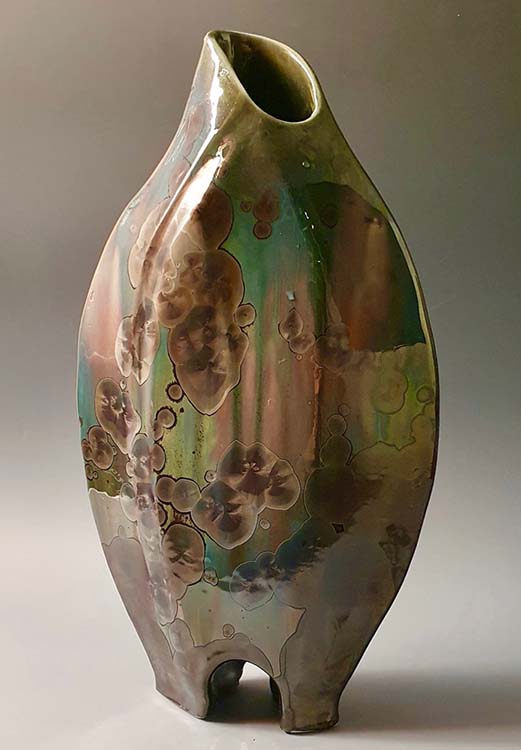
Being aware of and taking advantage of all these variables to achieve the crystalline glaze results one seeks is what makes crystalline glazes more than simply a glaze. I am not suggesting that other glazes are not used artistically, but rather that the artistry in crystalline glazes lies first in designing the form and second in creating glaze results that complement the form. Each artist brings slightly different goals and preferences to the desired surface outcome, and that diversity of intention is one of the variables I most appreciate.
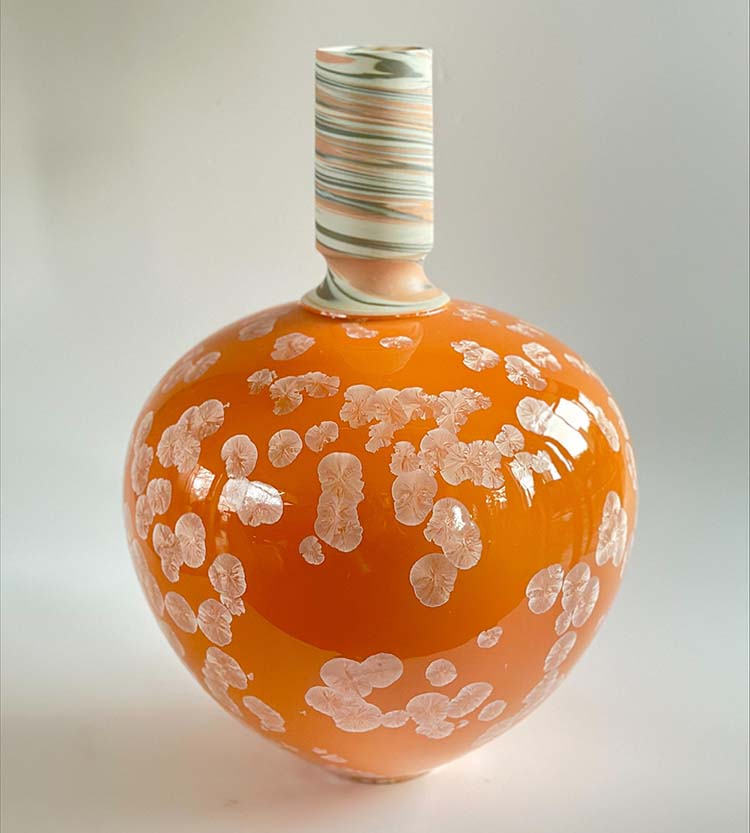
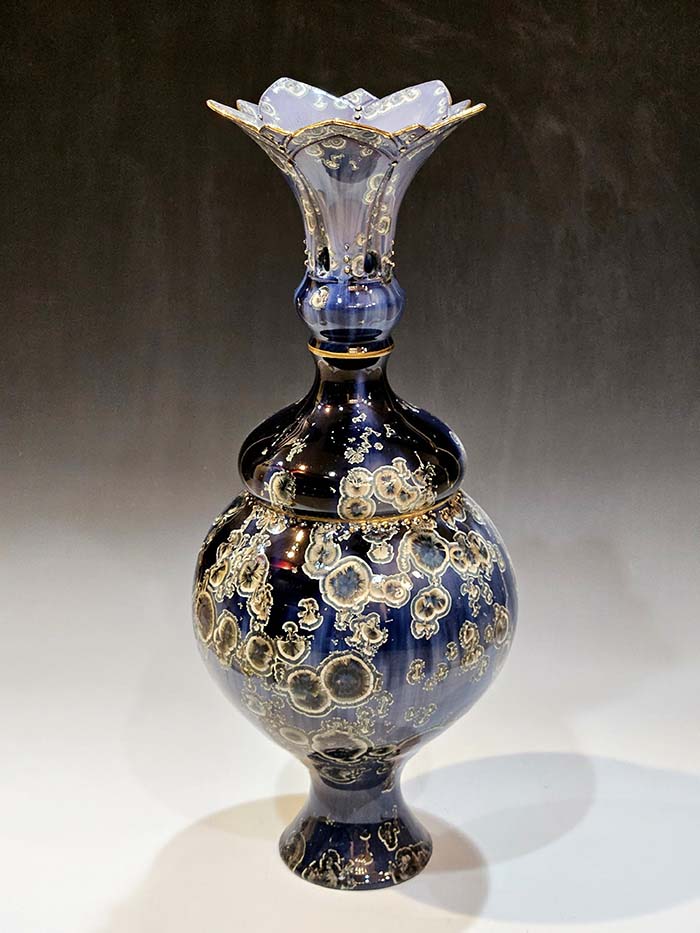
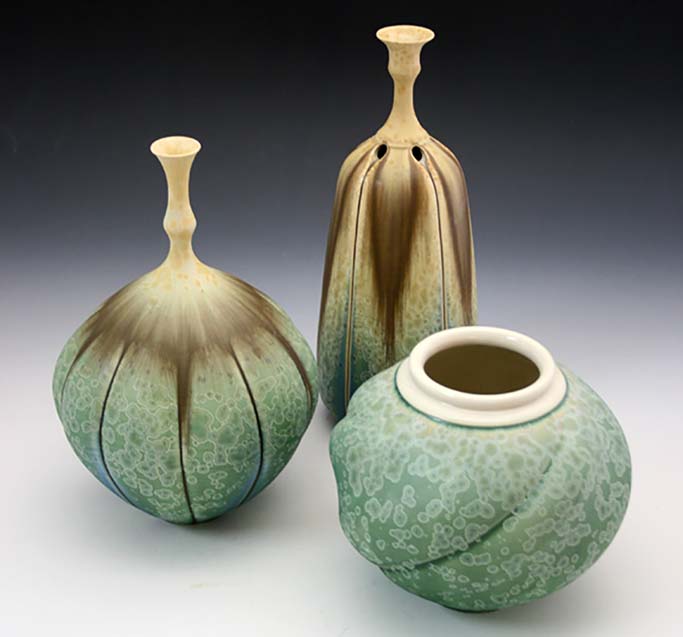
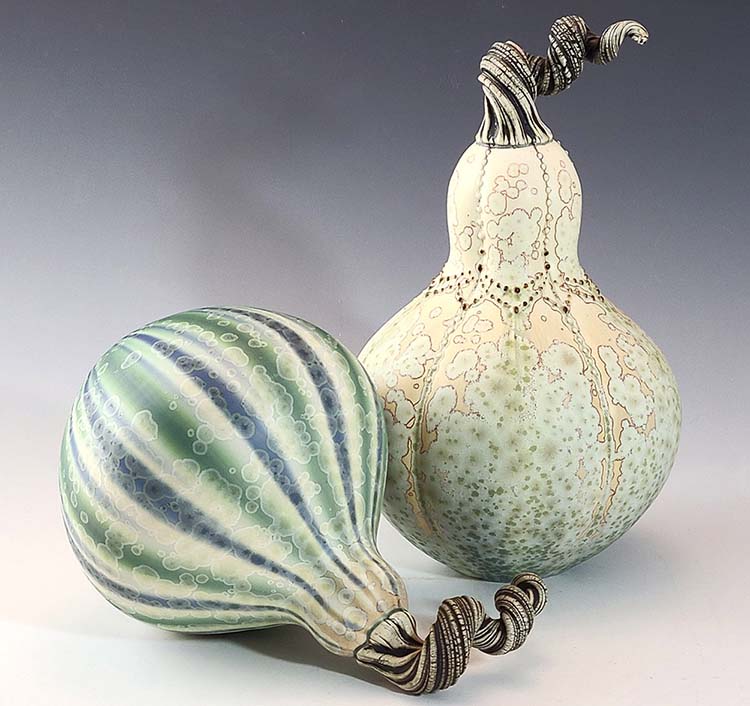
Traditionally, forms created for crystalline glazes were simple, uninterrupted shapes, creating a canvas-like surface that gave more focus and voice to the beauty of the crystalline structures in the glaze. At Pottery Boys Clay Studios, Keith Herbrand and I work together, each maintaining our own body of work while occasionally collaborating on shared pieces. Our work often, though not always, challenges those traditional principles–we create more complex pieces by altering the form, piercing the surface, carving patterns, and adding beaded collars. These intentional variations on tradition are, in part, our effort to create our own voice through glazes steeped in history. We are breaking the unspoken rules set forth by our predecessors, who understood that the complex nature of crystalline glazes is best displayed on simple, unaltered forms.
How Crystals Form
Of course, the first step is determining the temperature range in which you will be working and then formulating a glaze that functions within those parameters. Glaze formulation is another topic thoroughly addressed by American material specialists such as John Britt, José Maria Mariscal, and Matt Katz, to name a few. All of these experts offer both in-person and online workshop opportunities.
A simple cone 10 crystalline glaze recipe might begin with 50% Frit 3110, 25% silica, and 25% calcined zinc oxide. This combination produces white crystals on a clear ground. The color of this base glaze can be altered by incorporating common metal oxides in varying percentages. Rutile or titanium dioxide may be added as both opacifiers and crystal enhancers. Rare earth elements can also be introduced to achieve unique colors and to influence crystalline shapes and growth patterns. Start simply: adjust the base glaze formula to function well with the clay body you are using, and then move on to adding colorants.
While it is possible to fire these glazes in a kiln without a computerized controller, it is much easier to master them using one. Most electric kilns manufactured today come standard with computerized controllers, but it is still possible to order a more basic kiln with a standard kiln sitter, relying on a cone that melts at the target temperature. Of the ten kilns I have, nine have computerized controllers, and one is propane-powered (I use a digital pyrometer to measure heat and control the firing process). Four of my kilns are Bluetooth-enabled and can be monitored remotely.
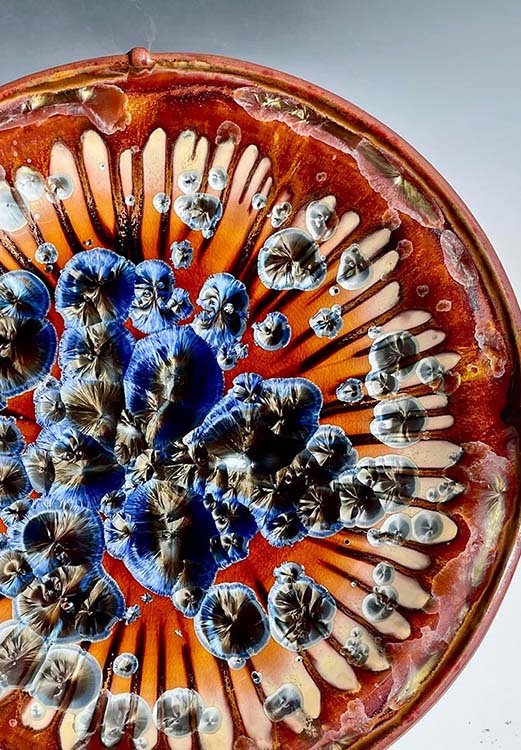
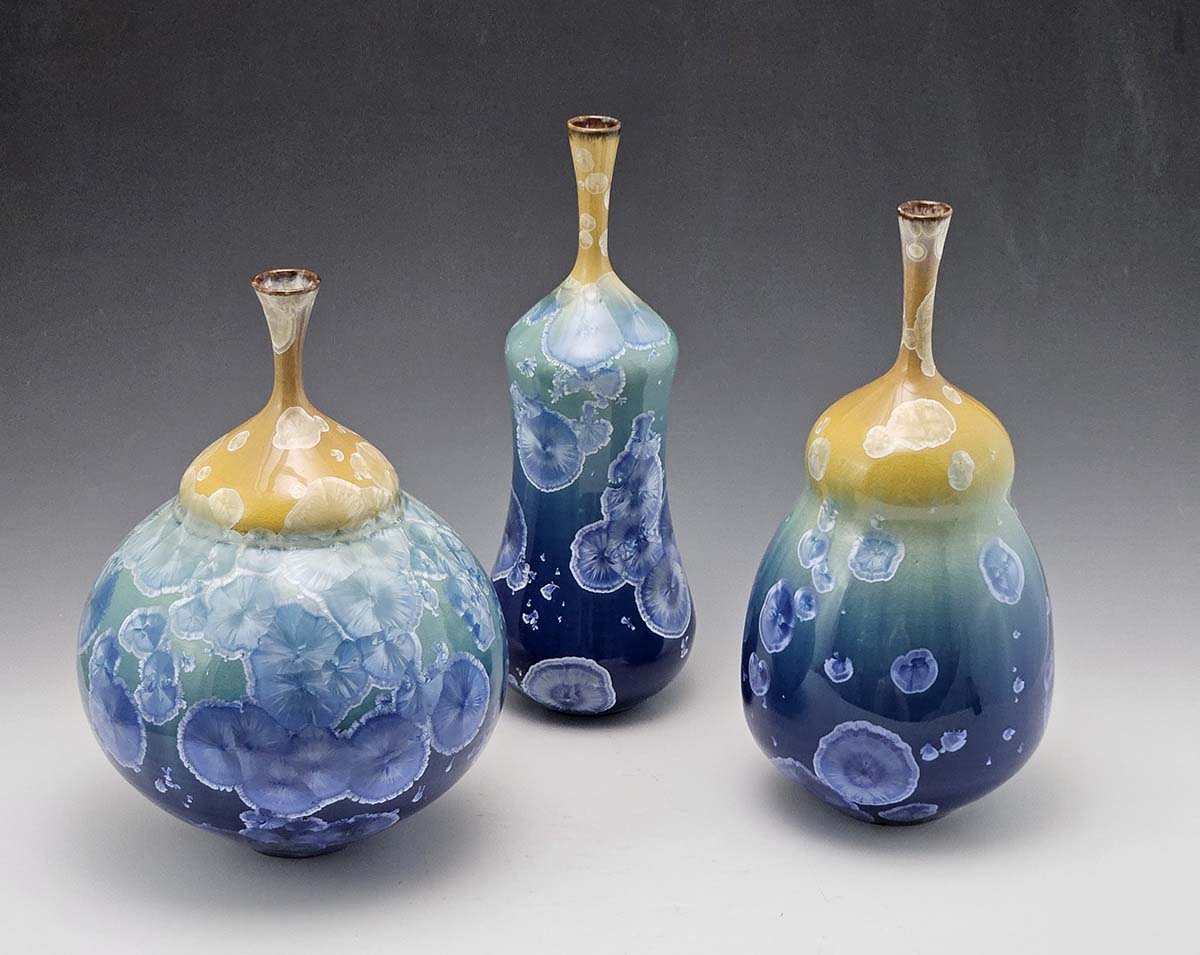
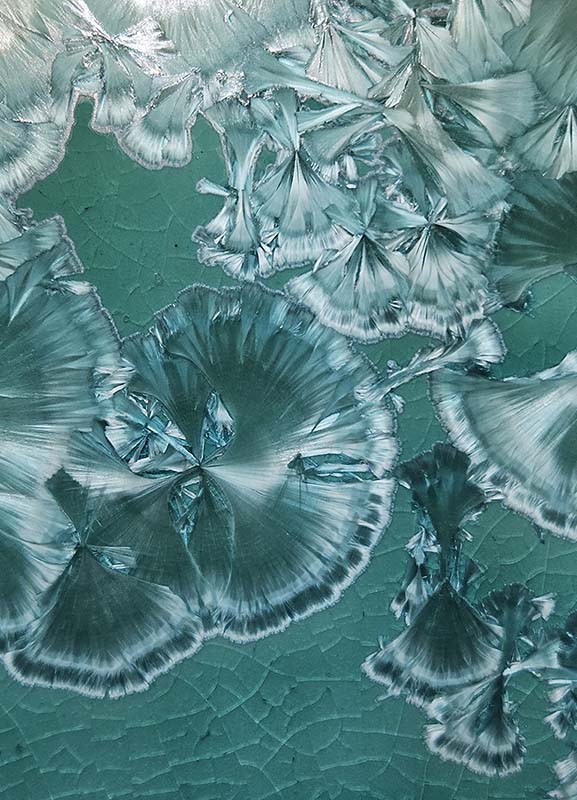
Designing an appropriate firing schedule is what makes this glaze unique. Once the glaze has melted at peak temperature—for our glazes, a true cone 10—we cool quickly, as fast as the kiln will naturally allow, to the temperature range in which crystals nucleate and form. The crystals must first nucleate, creating points from which dendrites, or needle-like crystalline structures, develop and grow as the glaze cools between 2030°F and 1800°F. At higher temperatures, where the glaze remains very fluid, crystals tend to be lace-like and may form shapes resembling axe heads or ginkgo leaves. At lower temperatures, such as 1900°F to 1800°F, the crystals typically grow into more symmetrical, rounded forms and are often less reflective.
We grow our crystals over an eight-hour period during the cooling cycle, moving quickly to and stopping at various temperatures, both rising and falling within the range mentioned above, and ultimately ending at a slightly higher temperature to encourage a lacy outline around the larger crystals. Soak times, or periods during which the kiln temperature is held constant, can range from 30 minutes to 3 hours at different temperature points, often resulting in several bands or rings of varying shades of color. Each ring indicates a change in temperature. To avoid forming distinct bands, one can move from the peak temperature to the lowest temperature at a very slow, steady rate. We use a descent of 30°F per hour; this method is known as a slant soak. Moving slowly to the lowest temperature provides the extended time needed to grow large crystals. Different frits may also lead to more aggressive crystalline growth.
With the addition of rutile and other titanium-containing materials, smaller secondary crystals may form at lower temperatures, typically between 1800°F and 1400°F. These secondary crystals create a more interesting visual texture in the areas between and around the primary macrocrystals, making the glaze even more visually stunning.
In this video, Ian Childers documents a crystal growing within the surface of his glaze. The kiln is fired up to cone 10 (2345°F) and then rapidly brought back down to 2000°F to begin the crystal growth cycle, where the video starts. The crystal begins growing at 2000°F, and he sets the kiln to hold at this temperature for one hour. He then drops the kiln to 1900°F for another hour, then 1800°F for another, followed by 1700°F for an additional hour, and finally 1600°F for a final hour before allowing it to cool on its own. Including the time it takes the kiln to cool 100 degrees between each step, the process takes about six hours in total to complete the final hold at 1600°F. The video is a time-lapse of this process, condensing those six hours into just under two minutes. As the kiln drops in temperature, the color of the glaze becomes visible at around 1600°F, where the video ends. This is because the camera setup overpowers the infrared light emitted at that temperature. This is also the point at which the crystal stops growing, and the kiln is allowed to cool naturally.
Ian Childers fires in an L&L kiln, a proud sponsor of MoCA/NY. The company produces a full line of kilns designed for crystalline glaze firing, including the JD230-JH model featured in the video. Explore the JH Seriesfor crystalline kilns.
The History of Crystalline Glazes
Historical accounts, such as Diane Creeber’s book Crystalline Glazes, suggest that these glazes were accidentally discovered by Chinese potters during the Song Dynasty (960–1279 AD). Although growing crystals may not have been their intention, the glaze formulas contained the necessary components to promote crystalline development. The kilns were often densely packed, slowing cooling and creating an ideal environment for crystals to form and grow. It is also suggested that oil spots, aventurines, and small crystalline structures emerged in these glazes as a result of slow cooling in densely packed kilns. Slow cooling cycles are a crucial part of the firing process for crystalline glazes; in this case, however, the effect was unintentional and led to the early discovery of crystalline-like surfaces.
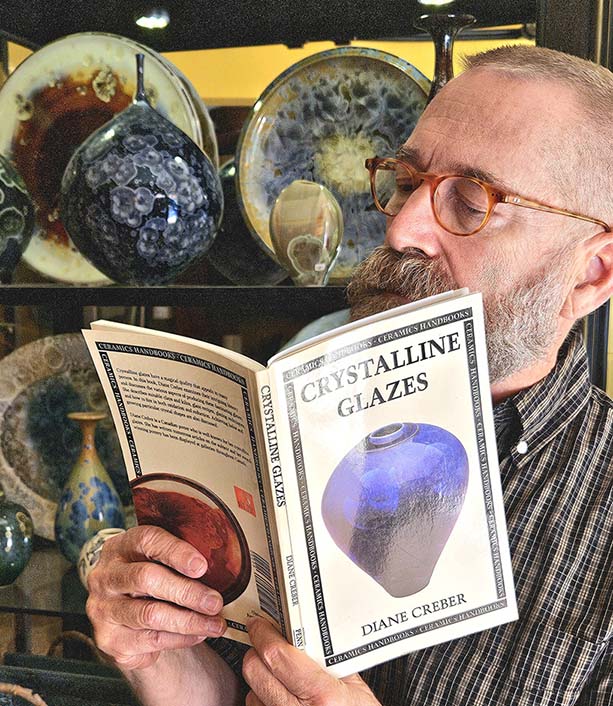
Diane Creber also notes in her book that these glazes were developed during the Art Nouveau movement in Europe (1880–1914). Jacques-Joseph Ebelmen, a Frenchman who worked at the Sèvres National Porcelain Manufactory from 1847 to 1852, is credited with developing early crystalline glazes during his time there. However, the Sèvres factory did not produce a commercially available line of crystalline glazes until 1897.
Crystalline glazes reemerged as early as 1885, and French glaze scientists are credited with being the first to successfully master them in the 1870s. It is often suggested that this period marks the true birthplace of crystalline glazes as we know them today: intentional glaze formulation, deliberate firing schedules, and carefully controlled, slow cooling cycles designed specifically to form and grow crystals.
Other figures to celebrate include Adolphe Clément and his successor, Valdemar Engelhardt of the Royal Copenhagen Porcelain Manufactory, both of whom worked very hard to develop crystalline glazes. Engelhardt is credited with developing the glaze into a realized artistic application. It was largely through his efforts that these glazes became internationally known, leading to yet another rebirth. By the late nineteenth century, Sweden, Germany, and other parts of Europe were ablaze with excitement over crystalline glazes.
The first documented use of crystalline glazes in the United States occurred in 1884 at Rookwood Pottery in Cincinnati, with the introduction of a glaze they called “Tiger Eye.” I have heard from other potters that the high failure rate and unpredictability of these glazes led many factories to abandon them, after which individual art potters resumed exploring them. During periods of economic hardship, particularly in wartime, crystalline glazes fell out of favor because the raw materials needed to produce them were difficult to obtain. Herbert Sanders’s book Glazes for Special Effects (1930) is credited with researching, developing, and reintroducing crystalline glazes to art potters. This book was further enhanced by an article by David Snair in Ceramics Monthly in 1975, which served as my introduction to crystalline glazes during my college years. I experimented with them then and vowed never to attempt them again—it was simply beyond my comprehension at the time.
Contemporary Use of Crystalline
There are many crystalline glaze groups and even workshops and forums online, making it much easier to learn about and find crystalline glaze recipes. Commercial glaze companies have offered premixed crystalline glazes, but many have not been very successful; it is much more likely that artists develop recipes to mix these specialty glazes in their own studios. Due to increased interest in crystalline glazes within the clay community, artists are offering workshops, both in person and online, to share their expertise and understanding of these glazes. Some are more focused on practical application (José Maria Mariscal), others on a scientific approach (Matt Katz), and yet others on a blend of the two (John Britt).
Artists working within more traditional crystalline glaze approaches include John Tilton (US), William Schran (US), Bill Powell (Australia), Ted Secombe (Australia), Ginny Conrow (US), Marsha Silverman (US), Matt Horne (UK), and Adi Turetzky (Israel), among many others.
Other artists have focused on expanding specific aspects of crystalline glazes through specialized techniques. These include post-fire reduction (Adi Turetzky, Israel); strike-fire effects (Holly McKeen, Canada); fat wood reduction (Robert Hessler, US); alcohol drip reduction (Jamie Kozlowski, US, and Annie Cap, UK); acid etch effects (Ian Childers and Andy Boswell, US); additional acid etch variations (José Maria Mariscal, Spain); glaze formulation research (John Britt, Matt Katz, Nick Ramos, and Lisa Zolandz, US); and high-fire reduction methods (Annie Cap, UK).
It seems as if there's a rebirth of crystalline glazes, rather than a reintroduction. This resurgence is seen as artists across the globe tune in on online crystalline glaze workshops or travel far and wide to attend weekend and weeklong programs dedicated to mastering these complex surfaces. What makes these workshops so exciting is that each artist brings a distinct perspective to mixing, storing, and applying glazes. Each has a personal definition of what constitutes a successful crystalline result, and all remain committed to refining those ideas with every firing.
My Personal Journey with Crystalline
It was not until 2007 that I revisited crystalline glazes after my first disastrous introduction to them in 1978–79. At the request of one of my students, Wilson Page, I organized a crystalline glaze workshop at the Dunedin Fine Art Center in Dunedin, Florida, where I learned foundational principles of glaze formulation, mixing, application, and firing schedules that opened my eyes to both the possibilities and the magic of crystalline glazes. I was hooked and quickly shifted my entire focus to working with porcelain and crystalline glazes.
My work as a crystalline glaze artist has been greatly influenced by observing the workshops and demonstrations of the artists mentioned previously. I am deeply grateful for the opportunity to learn from each of these presenters and look forward to continuing that exchange with others as this journey unfolds. If you were to look closely at any one of my pieces, I could tell you the influence behind it: a particular glaze formulation, an application technique, the use of acid to enhance the surface, or the decision to expose the glaze to a harsh environment in order to dramatically alter its color. Each work carries traces of those shared experiences, and I'm very lucky to have worked with so many of these very talented artists helping me along the way.
There are many failures along the way, but just as many successes that keep us eager to move forward with our formulas, firing schedules, and techniques. This is why I refer to it as “The Crystalline Journey.” If we're lucky, we're always moving forward and challenging long-held beliefs, learning new glaze chemistry and application, refining firing schedules, cultivating new and unexpected crystalline structures, and exploring how atmospheric variations transform the final surface.

Glenn Wood’s work is influenced by gourds, flowers, sea creatures, and patterns found in nature. He uses porcelain to create functional and decorative vessels. The surface he enjoys most is achieved using matte crystalline glazes; it is soft and more subtle than glossy crystalline glazes, allowing the carving, beading, and altering to come through beautifully. Glenn uses glossy crystalline glazes when a piece requires a little more bling.

He creates his work in two studios: Palm Harbor, Florida and Blue Island, Illinois. Woods and Keith Herbrand opened Pottery Boys Clay Studiosin 2001, where visitors can view more of his work, explore upcoming events, and purchase pieces.