524 W 19th St
New York, NY 10011
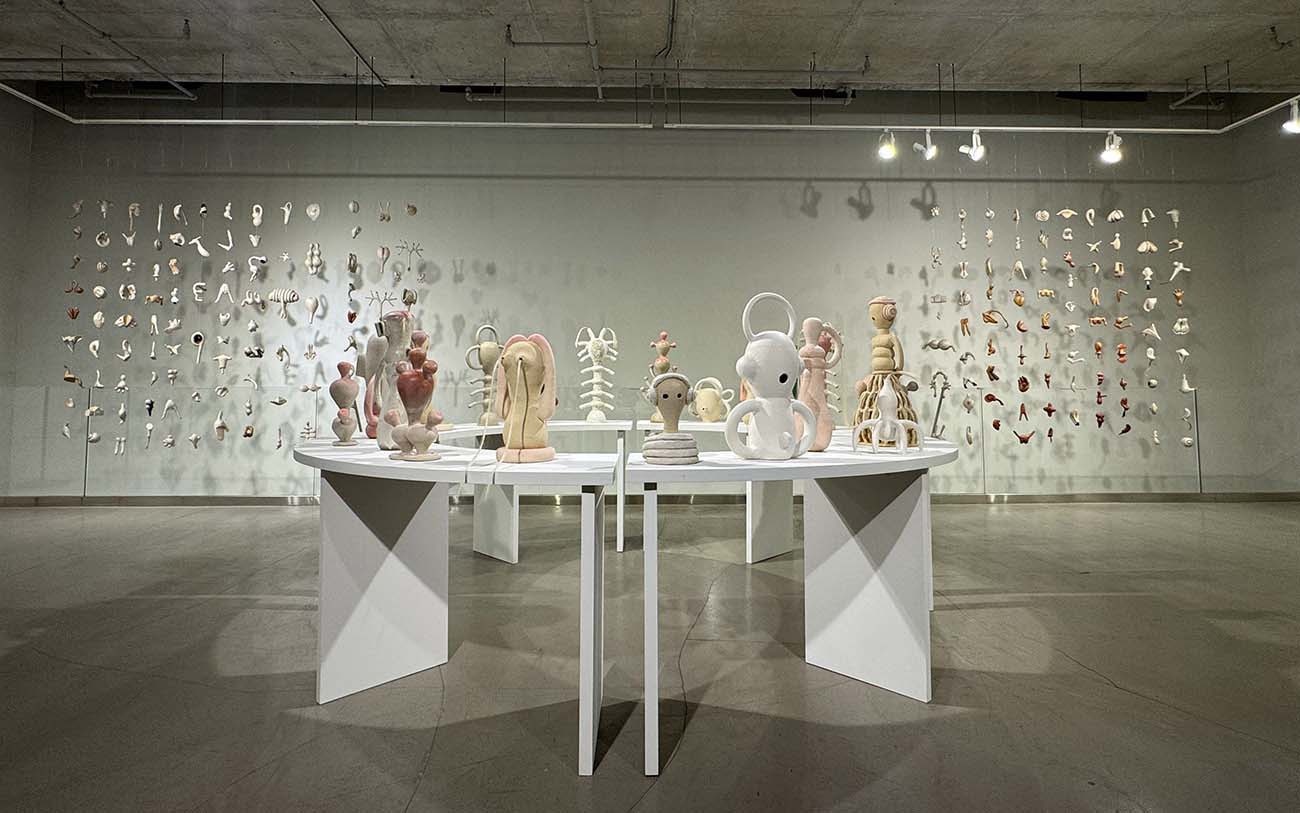
Jeanne Jaffe, a multidisciplinary artist, has been creating ceramic work for almost fifty years. Clay is at the root of nearly everything she makes. Her hand-sculpted ceramic figures serve as the basis for large-scale resin and fiberglass heads, all of which come to life in her videos, where they morph, liquefy, disintegrate, and reinvent themselves. Clay models are the first step in casting cotton linter paper. They form the molds for substantial bronze sculptures and inspire collaged drawings on paper; the drawings are later reproduced as printed tapestries. Jaffe’s solo exhibition, Becoming Hybrid, is currently on view through the end of January at L’Space Gallery in Chelsea, NYC. The show brings together works from across her practice, with her ceramic pieces taking center stage.
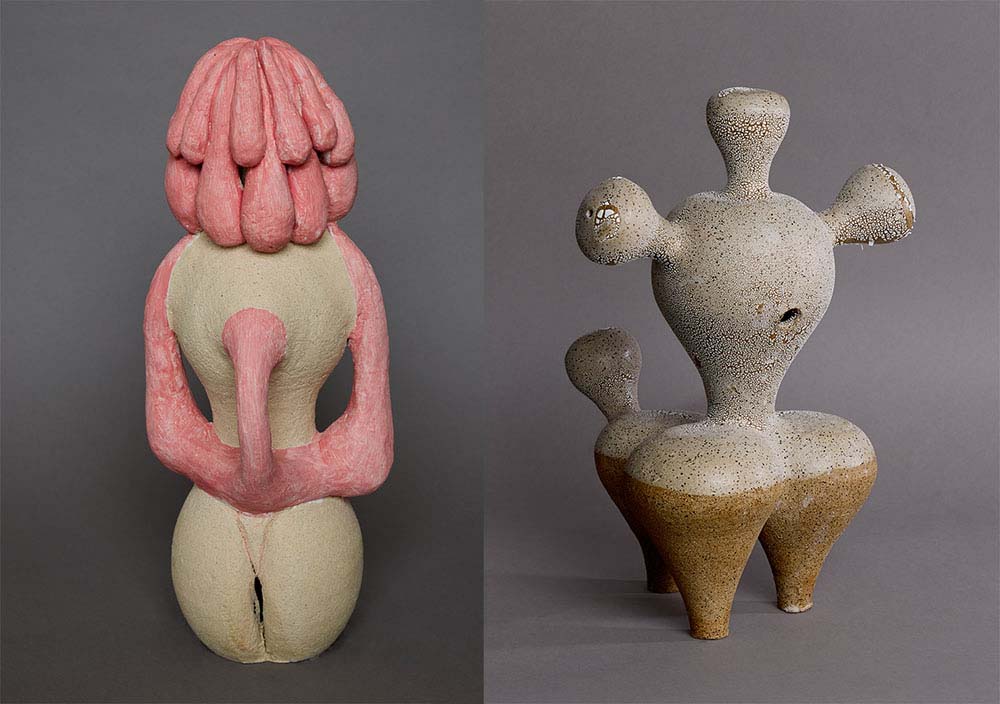
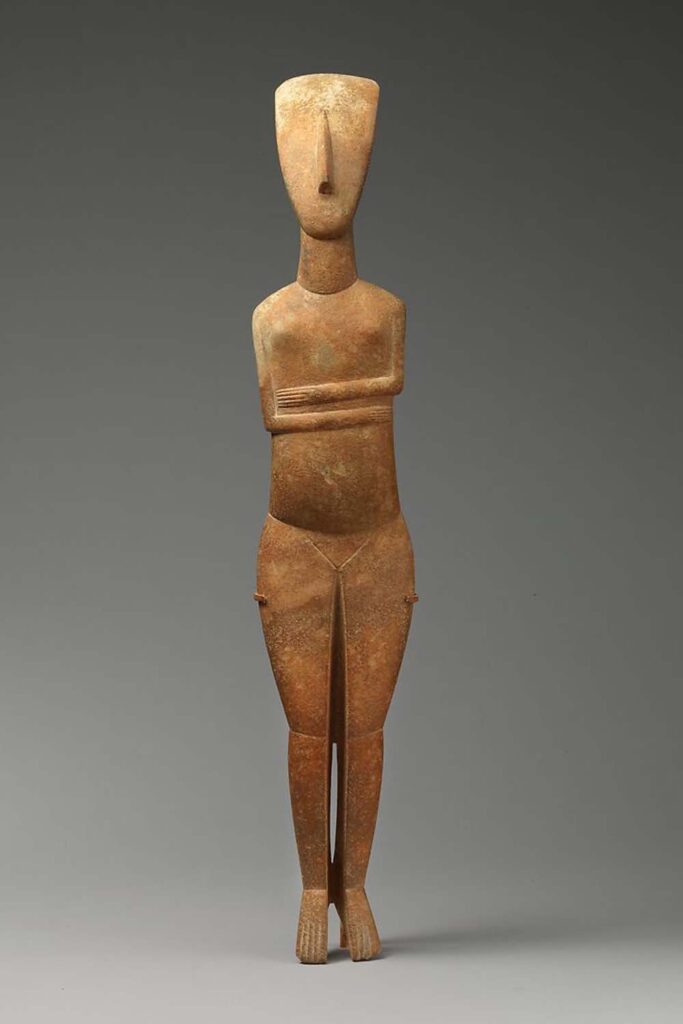
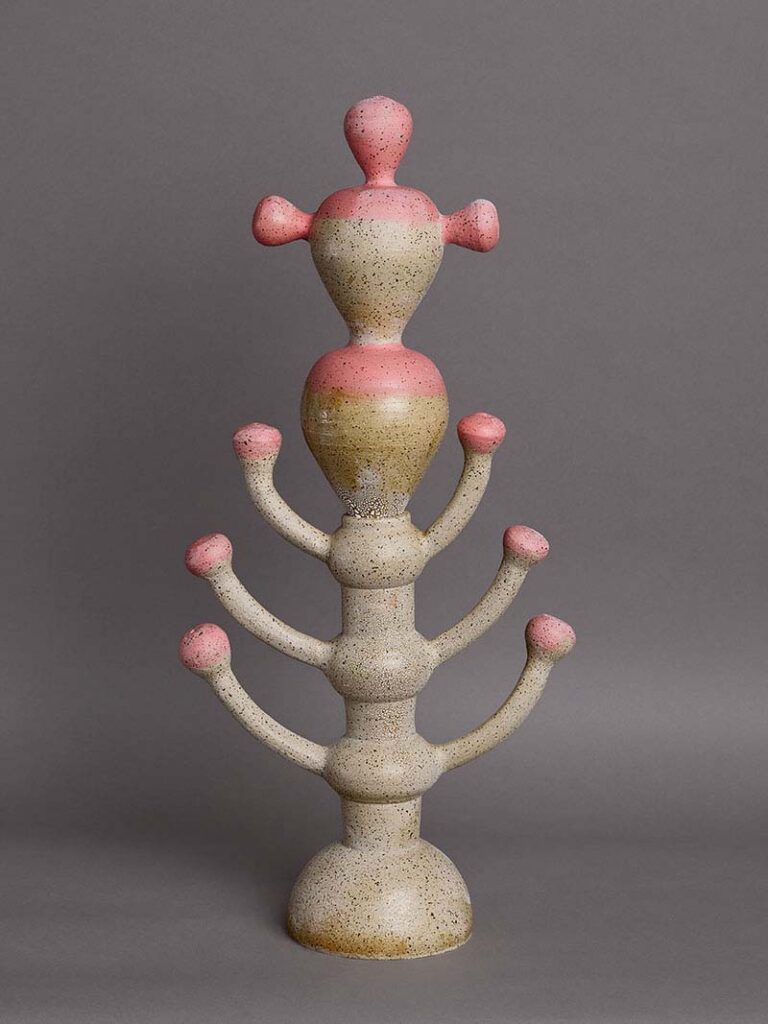
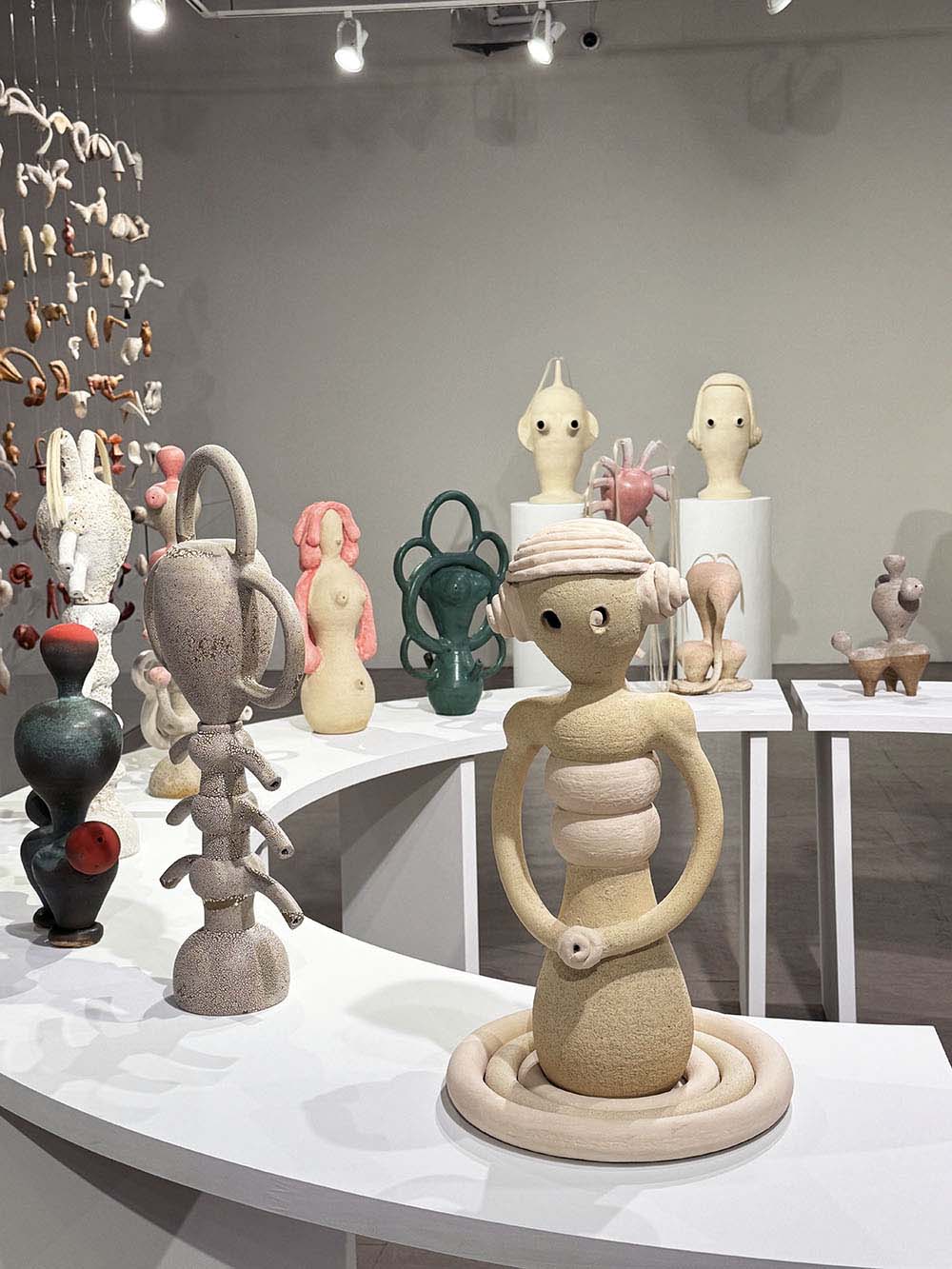
Jaffe cites the influence of ancient forms in her minimalist ceramic work. Her enigmatic figurines display qualities of the simple shapes and abstracted forms found in ancient Greek Cycladic art. Riffing on the iconic female figure with arms folded in front, she presents The Sentinel, Skirted Sentinel, and Lumina—three more rounded and ornamented variations on the theme—displayed on a circular platform in the middle of the gallery.
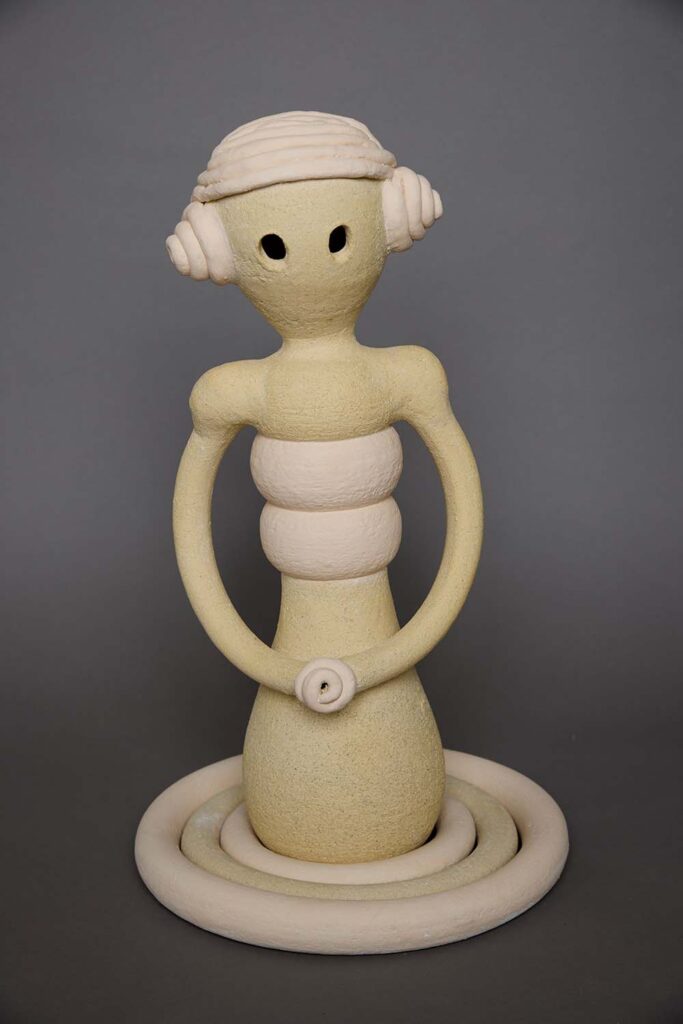
Her figures also reference Haniwa—hollow terra-cotta funerary statues from 3rd–7th-century Japan that were placed on and around graves. Oculus, Skirted Figure, and Phantom—adorned with ghostly pale synthetic hair—all contain holes where eyes would be, as well as openings in the backs of their heads. However, like all of her ceramics, they are crafted from stoneware.
Jaffe likes to think of her pieces as spirits or ghost figures, channeling a depth of connectivity that transcends realistic human portrayal and experience. Female Portrait Head and Male Portrait Head 2, both ceramic, stand at nearly two feet high, and the four-foot-tall fiberglass piece Pink Muse is one of two sentinels that greet guests as they enter the gallery. Their silence is made even more eerie by the complete absence of a mouth, their eye holes staring forward mutely and pulling the viewer’s attention to the hollowness within.
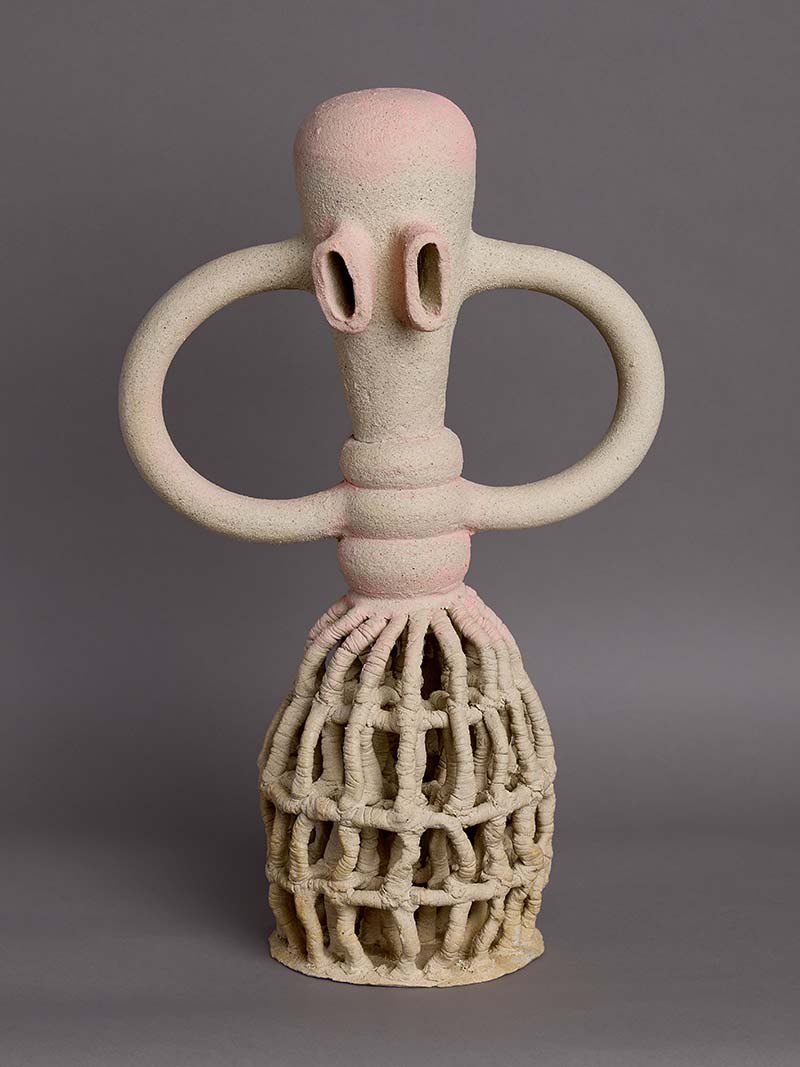
One can even detect aspects of the most stripped-down versions of ancient Persian and pre-Columbian figures in Jaffe’s work, conjuring the notion that she is tapping into universal qualities of human representation that transcend time, gender, and cultural specificities. With the exception of her stop-motion animation, Alice in Dystopia (a critical take on the status quo and its role in the devastation of our planet), Jaffe’s work is decidedly apolitical, as it does not engage in conversations related to beliefs or identities. Tapping into Carl Jung’s concept of the collective unconscious, and mirrored by a largely intuitive art-making process, she explores states of being that are about sensory experiences and realities that predate language, accessing universals that transcend differences. Jaffe’s pieces abstract our evolutionary animal roots, body parts, and other aspects of being human.
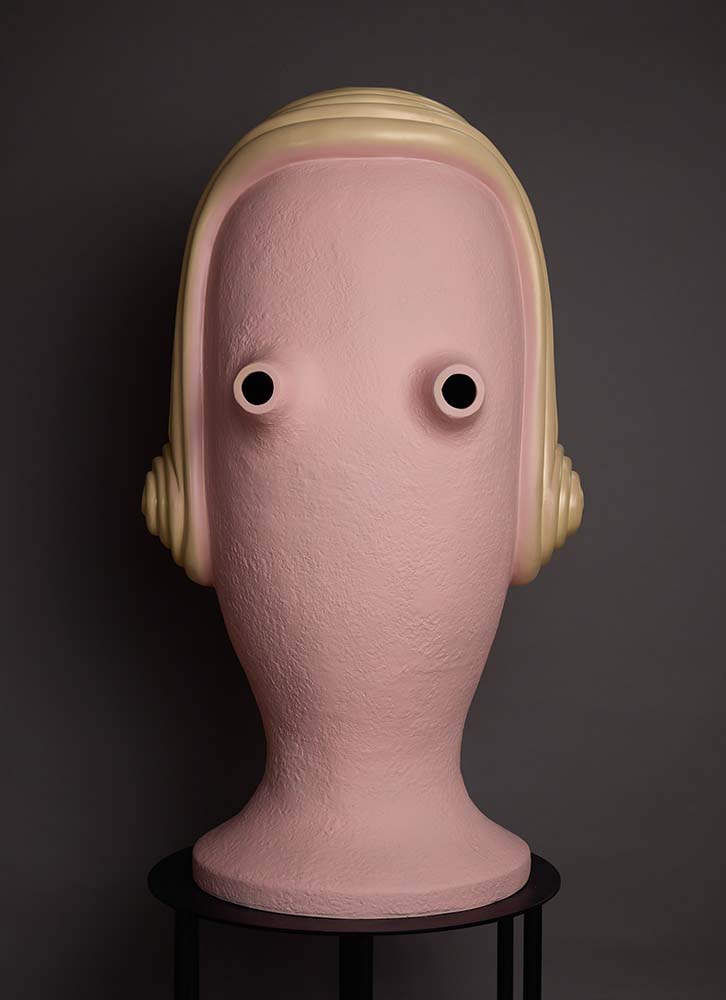
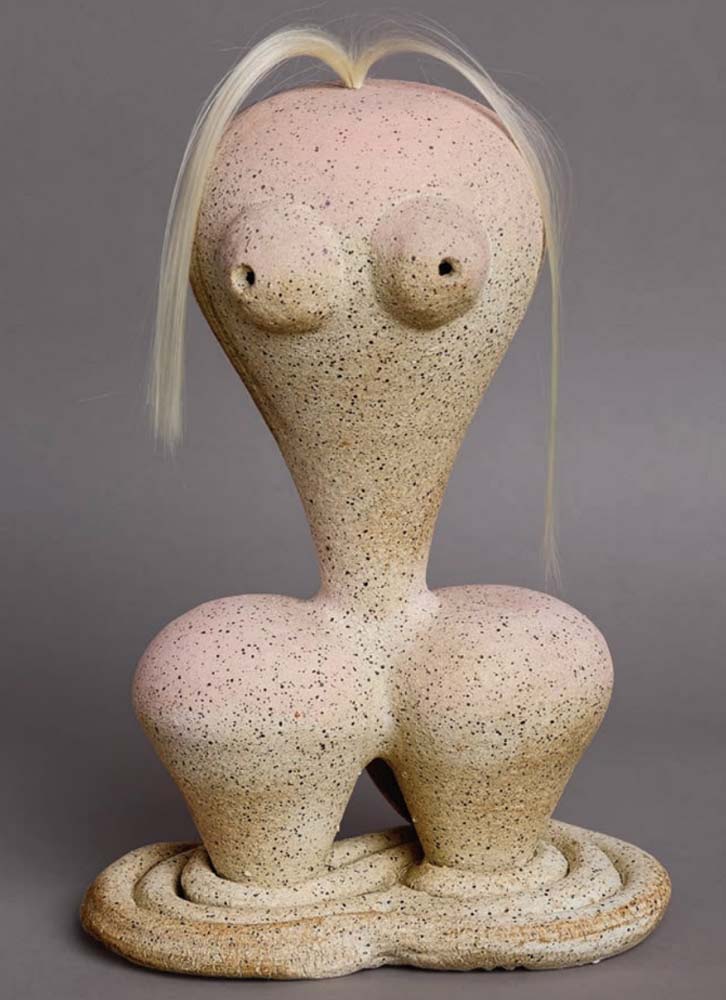
One of the main qualities Jaffe seeks to embody in these characters is a consciousness related to pre-verbal thinking, the exploration of a place of identity that predates linguistic differentiation. She explains, “Language names things, and once it names things, it separates them.” Her work taps into that state before these linguistic distinctions begin to be articulated. “There is a state where things are more united—shared identities and shared identifications, shared characteristics. You see this in nature all the time.”
Jaffe received her B.F.A. from the Tyler School of Art and Architecture and later earned her M.F.A. from the New York State College of Ceramics. After graduation, she moved to New York City, where she lived and made art for seven years, before relocating to Philadelphia. There, for over thirty-five years, she was a Professor of Interdisciplinary Fine Art at the University of the Arts, teaching Multidisciplinary Studies, Sculpture, and Critical Theory. Following that, she spent five years in China developing her own curriculum as a Visiting Professor of Sculpture at the Xi’an Academy of Fine Arts.
Her artistic practice has its roots in her early interest in archaeology. She spent her senior year of high school in Israel, where she studied ancient cultures, but her fascination with the subject continued beyond the brief period in which it was her academic focus. Her years in China, along with travels in Japan, Turkey, and Greece, enabled her to further explore the artistic developments, mythology, and early history of other cultures, bringing her full circle back to her first love: archaeology. Jaffe is captivated by the incomplete stories of artifacts from ancient traditions and the spaces they leave for the imagination.
There is indeed a haunting yet humorous quality to Jaffe’s figures. While they reference familiar archetypes, they can also appear rather alien, sitting as they do on the edge between the aspirational and the realistic. As she continues this exploration, she looks forward to depicting more fragments of figures, inviting viewers to participate even further in the co-creation of their meaning and significance.
While most of the work in Becoming Hybrid was made during the last couple of years, the exhibition also includes a collection of bronze sculptures Jaffe created in 2000. Bookending the adventurousness of her current ceramic pieces, the bronzes are more traditional, elegant suggestions of internal organs and body appendages, smooth and sleek precursors to the textured ceramics that would follow. The show also includes two drawings collaged with stitched thread, gold leaf, and small objects, as well as several tapestries inspired by these drawings. The various objects speak to one another as fragments of a whole, expressed through multiple media.
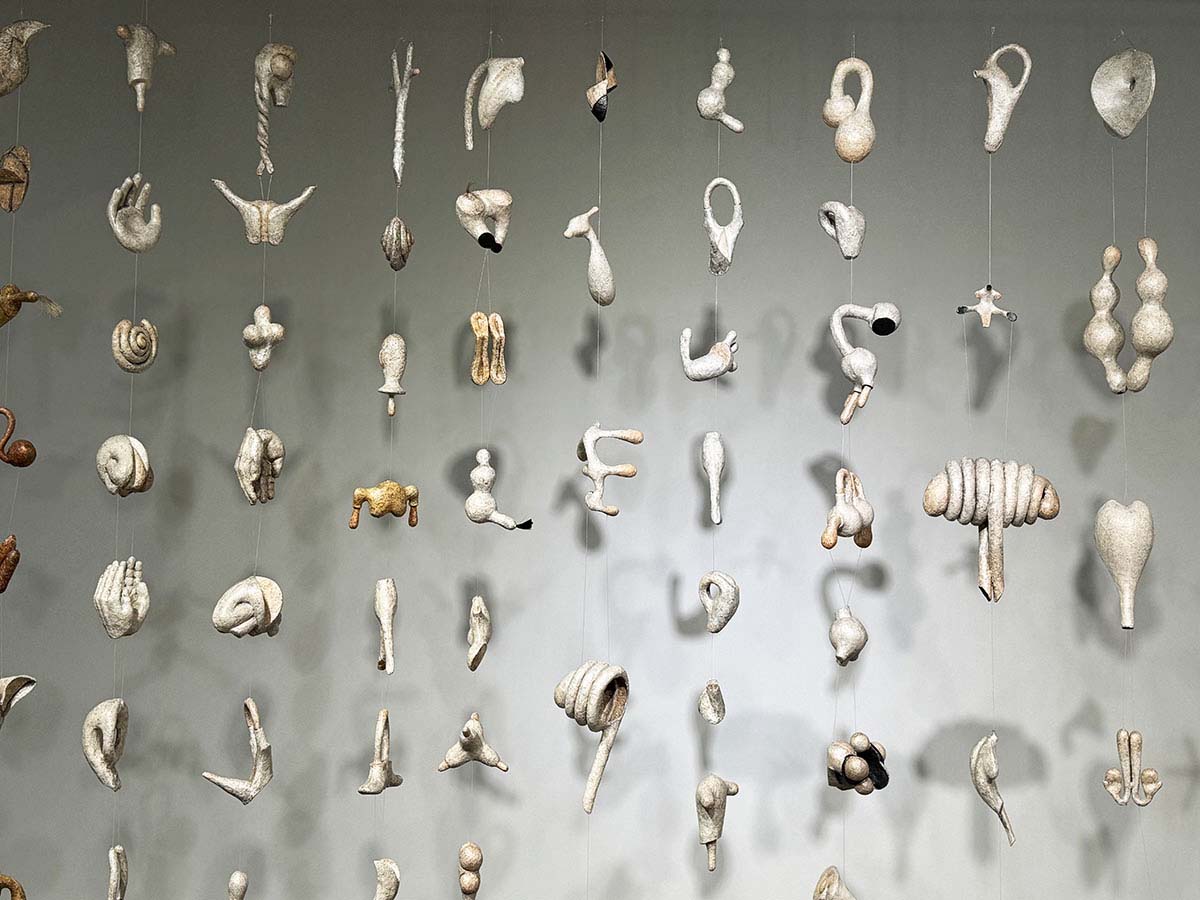
Across one side of the main gallery space, strands of cast cotton linter paper objects hang in rows, suspended from the ceiling like beaded curtains. Designed to look like stone, they take on the appearance of mysterious symbols, prehistoric glyphs arranged on floating papyrus, the components of a forgotten alphabet. In conversation with her other works, they complete the impression of stepping into a mythical realm unearthed from buried dreams, offering clues to a shared, collective unconscious. Jeanne Jaffe’s world invites visitors to look beyond notions of past and future. In Becoming Hybrid, she plants us firmly in a wondrous present that joins us in ways we have yet to discover.
To learn more about the exhibition, visit L'Space Gallery's website.
Deborah Oster Pannell is the Curatorial & Artist Relations Director for ARTMoney Society, a cultural strategy and artist development studio founded by Anthony-Michael Alexander. Her writing includes artist interviews and profiles for Interlocutor Magazine. Active in New York City’s visual and performing arts communities since the 1980s, she has worked as a writer, curator, producer, director, and performer—long enough to hold strong, well-informed opinions, including where one should and should not order pizza in the tri-state area.